
Cluster Pays Slots UK: How They Work Online
 Available in GB
Explore connected symbol groups, cascading wins, grid layouts, bonus features and play options at UK online casinos.
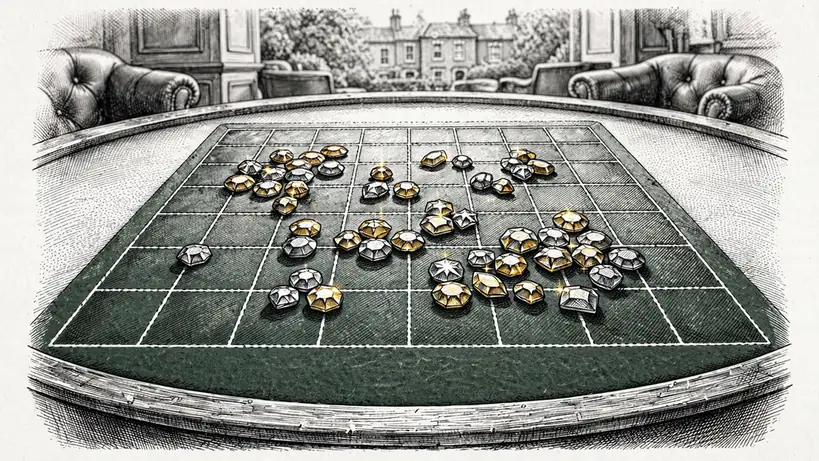
Table of Contents
- How Cluster Pays Slots Work
- Cluster Pays Wins, Cascades and Pay Mechanics
- Cluster Pay Slot Games, Machines and Demo Play
- Popular Cluster Pays Games and Their Features
- Cluster Pays Slots Online in UK Casinos
- Playing Cluster Pays Slots Online for Real Money
- Cluster Pays Slots with Bonus Rounds and Free Spins
- Responsible Play and Strategic Considerations
How Cluster Pays Slots Work
Cluster Pays slots use a grid rather than the fixed reels and paylines found in traditional slot formats. The symbols occupy individual positions across the playing area, and a winning combination is identified by the relationship between matching symbols on that grid. The arrangement makes the position of each symbol relevant: a symbol can contribute to a win when it touches another matching symbol in the required direction.
The grid size varies by game. A 7×7 or 6×6 layout is typical, while other titles use arrangements such as 5×5, 8×8, or a larger grid. The exact dimensions determine how many positions are available for symbols and how far connected groups can extend. They do not create conventional paylines. Cluster Pays slots have no paylines or fixed win paths, so the result depends on connected symbol groups rather than on symbols landing along predetermined lines.
Matching symbols on the grid
A cluster pays win requires matching symbols to be connected horizontally or vertically. The symbols must be adjacent, meaning that each symbol in the group touches another matching symbol in one of those directions. A group can run across a row, down a column, or turn between the two. It does not need to occupy a straight line.
This shortlist highlights UK operators for players exploring cluster pays slots in 2026. Use it to review licensing, available bonuses, payout speed and minimum deposit requirements at a glance.
License: UKGC Operator Licence · Bonus: £50 bonus · Payout speed: Within 48 hours · Min. deposit: £10 Platinum Gaming Limited holds a UKGC Operator Licence and offers a £50 bonus. Its stated payout speed is within 48 hours, with a £10 minimum deposit.
License: UKGC Operator Licence · Bonus: £20 bonus · Payout speed: Within 48 hours · Min. deposit: £10 Silverbond Enterprises is listed with a UKGC Operator Licence and a £20 bonus. Payouts are stated as being available within 48 hours, and the minimum deposit is £10.
License: UKGC Operator Licence · Bonus: £100 bonus · Payout speed: Within 24 hours · Min. deposit: £10 ProgressPlay Limited combines a UKGC Operator Licence with a £100 bonus. Its stated payout speed is within 24 hours, with a £10 minimum deposit.
License: UKGC Operator Licence · Bonus: £100 bonus · Payout speed: Within 24 hours · Min. deposit: £10 Genesis Global Limited is a UKGC-licensed operator offering a £100 bonus. The listed payout speed is within 24 hours, and the minimum deposit is £10.
License: UKGC Operator Licence · Bonus: £200 welcome bonus · Payout speed: Within 48 hours · Min. deposit: £10 32Red holds a UKGC Operator Licence and advertises a £200 welcome bonus. Its stated payout speed is within 48 hours, with a £10 minimum deposit.
License: UKGC Operator Licence · Bonus: £100 bonus · Payout speed: Within 24 hours · Min. deposit: £10 LeoVegas is listed with a UKGC Operator Licence and a £100 bonus. Payouts are stated as being available within 24 hours, and the minimum deposit is £10.
The minimum winning size is set by the individual game. A minimum cluster of five matching symbols is common, while the required size can be between five and eight connected symbols. The relevant condition is therefore not simply the presence of several identical symbols. They must form one qualifying group under the game’s connection rule.
For example, five matching symbols arranged in a continuous horizontal or vertical pattern may qualify, provided the game uses that minimum. Five identical symbols separated by other symbols do not form a cluster. Likewise, matching symbols positioned near one another but not sharing a permitted edge remain separate groups.
Some Cluster Pays slots also allow diagonal connections. This changes the way groups can be formed because symbols touching at a corner may be treated as adjacent under that game’s rules. Diagonal linking is not universal, so the connection pattern must be established from the individual slot’s rules rather than assumed from the grid itself. Where diagonal links are not enabled, horizontal and vertical contact define the cluster.

What happens after a winning cluster
The defining sequence begins when the game identifies one or more qualifying groups. Winning symbols are removed from their positions. The empty spaces are then filled by new symbols falling from above. This process is generally described as cascading reels, although the visual presentation remains grid-based rather than a set of conventional paylines.
The replacement symbols can create further connected groups. If another qualifying cluster appears after the fall, those symbols are also removed and new symbols drop into the vacant spaces. The sequence continues while each new arrangement produces an eligible cluster. A single initial spin can therefore contain several successive winning events without a separate spin button being used between them.
The cascade ends when the latest symbol fall produces no new qualifying group. At that point, the grid is settled and the spin is complete, unless the game applies another feature that changes the board. The essential cycle is:
- Symbols fill the grid.
- Adjacent matching symbols are assessed.
- Qualifying clusters are removed.
- New symbols fall from above.
- The replacement layout is checked again.
- Cascades stop when no new cluster forms.
This removal-and-fall process distinguishes the format from a traditional reel result. In a conventional slot, the visible reel positions normally remain in place after a winning combination is evaluated. In a Cluster Pays game, the winning positions are cleared, and the board is reconfigured during the same spin.
How the grid changes the playing structure
Because wins are based on groups rather than lines, symbols can contribute from many positions on the board. A qualifying group may begin near an edge, occupy the centre, or connect several rows and columns. The absence of fixed paths means that the same symbol arrangement can have different consequences depending on which symbols touch after each cascade.
The grid also makes the number of available positions important. A 7×7 layout provides a different field from a 6×6 grid, while an 8×8 arrangement creates still another pattern of possible connections. Grid size alone does not establish the minimum cluster or whether diagonal links are allowed. Those rules belong to the specific game.
Format Grid-based (no paylines)
Winning Logic Connected symbol clusters
Key Feature Cascading reels
Common Layouts 6×6, 7×7, 8×8 grids
Cluster slot terminology is sometimes used broadly for this family of games, but the defining elements remain consistent: a grid, matching symbols, an adjacency rule, a stated minimum cluster, and removal followed by falling replacements. Cascading wins are a typical feature because the removal of one group changes the positions around it and can produce new groups. The result is a sequence of connected evaluations within one spin, rather than one fixed line-based calculation.
Cluster Pays Wins, Cascades and Pay Mechanics
Cluster pays slot mechanics differ from the fixed-line structure used by traditional slot machines. A conventional game evaluates symbols along predefined paylines, whereas a cluster pays game evaluates adjacent matching symbols across a grid. There are no fixed win paths in the cluster format. The relevant relationship is spatial: matching symbols must form a connected group, generally through horizontal or vertical contact.
Cluster pays versus paylines and scatters
The distinction between cluster pays and paylines concerns how a winning arrangement is identified. In a payline game, the position of a symbol matters because it must occupy one of the selected lines. A matching symbol outside those lines does not contribute to that particular result. Cluster pays remove this line-based condition. A qualifying group can appear in different parts of the grid, provided its symbols remain connected under the game’s stated rules.
Scatter wins use a third method. Scatters do not need to be adjacent or arranged along a particular route. They award a result when a sufficient number of scatter symbols appears anywhere on the reels or grid. Thus, a cluster win depends on connection, a payline win depends on a predefined route, and a scatter win depends on the required symbol count in eligible positions.
This difference is central to cluster pays explained in practical terms: the grid is assessed for groups rather than for lines. The same spin can therefore contain several separate matching groups if each group satisfies the game’s qualifying condition. The exact minimum cluster size is determined by the individual title, so the presence of matching symbols alone does not establish a win.
How cluster wins are calculated
When a qualifying group is identified, its value is calculated from the symbols included in that group and the game’s paytable. Connected symbols of the same type form the relevant unit, rather than a sequence selected by a payline setting. If more than one qualifying group appears, each group can be evaluated as a separate outcome according to the game’s rules.
The arrangement of symbols can also affect the number of outcomes produced by one initial spin. A grid may contain several disconnected groups of the same symbol, and those groups are not automatically treated as one cluster if other symbols separate them. Conversely, a single connected group may extend across a substantial part of the grid. This makes the visible pattern important to the calculation, although the paytable remains the authority for the value assigned to it.
Some cluster pays games also include multipliers or bonus triggers during base gameplay. A specialist industry review reports these features as present in cluster pays games, but that observation is not a universal rule for the format. Their existence, activation conditions, and effect must therefore be established from the rules of the individual game rather than inferred from the cluster mechanism itself.
Cascading reels and repeated outcomes
Cascading reels are closely associated with cluster pays. After a qualifying group is awarded, the winning symbols are removed from the grid. Symbols above the empty positions then fall into them, and new symbols enter from above. The resulting arrangement is checked again for further qualifying clusters.
Cascading wins allow a single initial spin to produce several successive winning events as new symbols fall into vacant spaces.
This sequence can continue while each new arrangement creates another valid group. A single paid spin may consequently produce several successive outcomes without a separate spin command for every stage. Each cascade is a new evaluation of the changed grid, not a repetition of the original symbol layout. If no new qualifying cluster forms, the cascade sequence ends and the spin is complete.
The duration of one spin can therefore be longer than the visual event associated with the initial grid. A sequence may stop after the first evaluation or continue through multiple symbol falls, depending on the outcomes created by each removal. Cascading reels do not guarantee a further win; they only provide the mechanism through which additional evaluations can occur.
Payout frequency and volatility
Cluster pays slot wins are shaped by both the qualifying rules and the game’s volatility. Many modern cluster pays titles are described as highly volatile, with larger payouts occurring less frequently. That description concerns the distribution of results, not a prediction about any particular spin. A cascade may produce several outcomes, but the number of stages does not by itself establish that the total result will be positive.
The mechanics should therefore be separated from the financial interpretation. Adjacency determines whether a cluster qualifies, the paytable determines its stated value, and cascading reels determine whether the altered grid receives another evaluation. These are distinct parts of the same game flow, and none changes the underlying chance of the symbols appearing.
Cluster Pay Slot Games, Machines and Demo Play
Cluster-pay games are available in machine-style formats that replace the familiar reel-and-payline presentation with a symbol grid. The visual language may still include a spin button, stake controls, a balance display, and animated wins, but the underlying layout is different. A game can therefore resemble a conventional online slot while determining wins through connected groups rather than fixed win paths.
7×7 grid layout with high volatility.
8×8 grid layout with high volatility.
96.83% RTP and medium volatility.
96.50% RTP and high volatility.
The format is not confined to one grid size. Reactoonz uses a 7×7 grid, while Jammin’ Jars uses an 8×8 grid. These examples show how cluster-pay machines can vary in both presentation and playing area. A larger grid may display more symbols at once, but grid size alone does not establish the value of a game, its volatility, or the frequency of its features. Those characteristics depend on the individual game rules.
How machine-style cluster games differ
A cluster-pay slot machine normally presents symbols across a square or rectangular field. The central visual task is to identify matching symbols that touch in the permitted directions. The result is more open-ended than a fixed-line slot because a win does not depend on selecting or following one of a predetermined set of paylines.
The games may differ in several practical respects:
- the number of rows and columns in the grid;
- the minimum number of connected matching symbols required for a win;
- whether diagonal connections are recognised;
- the symbols used for ordinary and special functions;
- the way new symbols enter the grid after a winning group disappears;
- the conditions attached to bonus triggers.
These differences matter when comparing cluster pay slot games. Two titles can share the same broad format but produce a distinct playing experience because their grids, symbol distributions, and feature rules are not identical. A machine with a larger playing area is not automatically more generous, and a visually complex interface does not by itself indicate a higher potential return.
The presentation can also influence how easily the outcome is read. Clear highlighting of connected symbols makes it possible to follow the winning group before it is removed. Conversely, rapid animation can make a long sequence difficult to inspect while it is occurring. Demo play is particularly useful in this respect because it permits observation of the interface without treating the session as a real-money gambling activity.
What a cluster pay slot demo can show
A cluster pay slot demo allows the game to be examined before real-money play. Its principal value is informational: it can show how the grid is arranged, how matching symbols are marked, and how the machine presents the result of a spin. It can also help establish the size of the clusters that the game recognises and the circumstances in which bonus triggers appear.
A structured demo review can examine:
- Grid presentation. Reactoonz displays a 7×7 grid, whereas Jammin’ Jars displays an 8×8 grid. The difference is immediately visible and provides a concrete indication of how much of the playing field is active at once.
- Cluster recognition. The demonstration can reveal whether matching symbols must connect horizontally and vertically or whether the particular title also permits diagonal contact.
- Removal sequences. When a winning group is removed, the movement of replacement symbols shows how the game handles subsequent outcomes during the same spin.
- Feature signals. Special symbols, counters, visual effects, or dedicated messages may indicate that a bonus condition has been met or is being approached.
- Information panels. The paytable and help screens can clarify the relevant symbol rules and identify feature descriptions supplied by the game itself.
The demo does not establish that a future real-money session will reproduce the same sequence. Nor does it convert the game into a method of assessing likely personal profit. Its proper use is limited to familiarisation with the rules, interface, and documented features.
Comparing formats without confusing presentation and performance
The term “machine” describes the slot format and interface, not a physical device or a guarantee of a particular outcome. Cluster pay slot machines may be encountered in online environments as digital games with different grid dimensions and feature structures. Their appearance can suggest similarity even when their mathematical profiles differ.
Published figures illustrate this point. Gemix is listed with a 96.83% RTP, medium volatility, and a 4,513x maximum win. Moon Princess is listed with a 96.50% RTP, high volatility, and a 5,000x maximum win. These figures belong to the individual games and should not be treated as general properties of every cluster-pay title. The contrast also shows why grid design and visual style cannot substitute for title-specific information.
Legal Requirement
In Great Britain, online gambling services must be provided by an operator holding a valid remote operating licence from the UK Gambling Commission.
RTP is a long-run mathematical measure rather than a forecast for a particular session. Volatility describes the distribution of outcomes, not the quality of the interface or the likelihood that a demo sequence will recur. A maximum-win figure identifies a stated upper outcome, not an expected result. None of these measures can be inferred reliably from the number of rows, the animation speed, or the apparent frequency of visible clusters.
A practical demo checklist
A short, methodical examination is more informative than judging a title by its graphics alone. The following points can be recorded while using a demo:
- the grid dimensions and the location of the main play area;
- the minimum connected group stated in the paytable;
- the directions in which symbols may connect;
- the appearance of winning groups before removal;
- the manner in which replacement symbols enter the grid;
- the visual or textual signs associated with bonus triggers;
- the RTP, volatility, and maximum-win information when the game provides them.
This process separates observable mechanics from assumptions about performance. It also makes comparisons between games more precise. Reactoonz and Jammin’ Jars, for example, can be distinguished immediately by their 7×7 and 8×8 layouts, while Gemix and Moon Princess require title-specific information to compare their listed RTP and volatility profiles.
Demo mode therefore functions as an explanatory environment rather than a substitute for the conditions of real-money play. It can clarify how a cluster-pay game is organised and how its features are displayed, but it cannot demonstrate that a particular bonus will appear in a later session or that a sequence represents a dependable financial opportunity. Affiliate links on this page may result in a commission if a user signs up through them.
Popular Cluster Pays Games and Their Features
The documented characteristics of cluster pays titles differ substantially. RTP indicates the theoretical return specified for a game, while volatility describes the frequency and distribution of outcomes. A maximum-win figure expresses the highest advertised win in relation to the stake. These measures describe different aspects of the same title and should not be treated as interchangeable.
A comparison of selected titles
| Game | RTP | Volatility | Maximum win |
|---|---|---|---|
| Reactoonz | 96.51% | High | 4,570x |
| Jammin’ Jars | 96.83% | High | 20,000x |
| Aloha! Cluster Pays | 96.42% | Low-medium | 700x |
| Sticky Bees | 96.06% | High | 10,000x |
Reactoonz is a high-volatility title with a documented RTP of 96.51% and a 4,570x maximum win. Its 7×7 grid is one of the identifiable structural features associated with the game. The combination of high volatility and a stated maximum win places it among cluster pays slot games where larger outcomes are not represented as a measure of regularity.
Jammin’ Jars uses an 8×8 grid and is listed with a 96.83% RTP, high volatility, and a 20,000x maximum win. Among the four compared titles, it has the highest documented maximum-win figure and the highest listed RTP. Those two measurements do not establish how often either result occurs; they are separate specifications of the game.
Aloha! Cluster Pays has a 96.42% RTP, low-medium volatility, and a 700x maximum win. Its documented maximum win is lower than the figures listed for the other titles in this comparison. The low-medium volatility classification also distinguishes it from Reactoonz, Jammin’ Jars, and Sticky Bees, each of which is recorded as high volatility.
Sticky Bees is documented with a 96.06% RTP, high volatility, and a 10,000x maximum win. Its maximum-win figure is below Jammin’ Jars but above Reactoonz and Aloha! Cluster Pays. The listed RTP is also the lowest among these four examples, although the difference between RTP values should not be read as a prediction of an individual playing session.
Interpreting the feature set
The comparison shows why cluster pays casino games cannot be assessed through a single headline statistic. RTP concerns the theoretical return stated for the title. Volatility concerns the pattern of wins. The maximum win identifies the upper boundary recorded for the game. A title with a higher maximum win is not thereby more likely to produce that outcome, and a lower-volatility classification is not a guarantee of a particular result.
The available figures also show that the category includes more than one design profile. Aloha! Cluster Pays is listed with low-medium volatility and a 700x maximum win, whereas Jammin’ Jars combines high volatility with a 20,000x maximum win. Reactoonz and Sticky Bees occupy different points within the same high-volatility classification, with maximum-win figures of 4,570x and 10,000x respectively.
Essential Regulations
- UK operators must hold a UKGC licence to offer games legally.
- Players must be at least 18 years old to participate.
- Operators are required to provide tools like deposit limits and self-exclusion.
- Credit card gambling is prohibited in the UK.
For a catalogue of cluster slot games, these documented specifications provide a clearer basis for comparison than labels such as “popular” or “high paying”. The figures apply to the listed titles and do not establish a general rule for all cluster pays slot features. Where a game has different published configurations, the relevant version would need to be identified before comparing its RTP or other measurements.
Cluster Pays Slots Online in UK Casinos
The availability of cluster pays games in a UK online casino depends on the operator’s legal status, not merely on whether a title appears in its game lobby. For consumers in Great Britain, an operator providing online gambling services must hold a remote operating licence from the UK Gambling Commission (UKGC), regardless of where the business is based. This requirement applies to casinos offering grid-based titles, including online cluster pay slots.
The Gambling Act 2005 is the primary legislation governing gambling in Great Britain. The UKGC, established under that Act and given full powers in 2007, issues operating, personal and premises licences. Its public register records current operating and personal licences, giving the market a formal means of checking whether a casino is authorised.
Establishing whether a casino is authorised
A licence check should concern the operator behind the website rather than the appearance of a UK-themed interface or the presence of familiar games. The UKGC register can be searched by operator name or licence number. The domain listed in the register must also correspond with the website offering the games. This domain check matters because an authorised business name does not, by itself, establish that every associated website is covered.

The Commission assesses applicants in areas including identity and ownership, finances, integrity, competence and criminality. These assessments form part of the regulatory basis for accepting online gambling activity in Great Britain. The standard application processing time is approximately 16 weeks, and application fees are non-refundable whether or not a licence is granted. These administrative facts concern operators rather than players, but they explain why licensing is a substantive legal condition rather than a decorative badge.
Operators must hold a UKGC licence to advertise or take bets from consumers in England, Wales or Scotland. Operating without one is a criminal offence. Consequently, a casino that lists a cluster pays slot but cannot be matched to a current UKGC record should not be treated as a lawful option for those jurisdictions.
What a regulated online casino environment includes
UK remote operators must belong to GAMSTOP, the national online self-exclusion scheme. They must also connect to a nationwide database of self-excluded users and enforce strict age control. The legal gambling age is 18, and parental permission does not alter that requirement. No form of gambling is legal under the age of 16 in the UK; for cluster pays games offered through a licensed online casino, the relevant participation threshold is therefore 18.
Regulatory requirements also cover the handling of deposits and accounts. Operators must prompt players to set a deposit limit before the first deposit. They must provide controls including deposit limits, loss limits, session time limits, reality checks, self-exclusion and timeouts. Self-exclusion must be available for a minimum of six months. These measures are part of the operating environment in which a UK casino offers an online casino cluster pays slots section; they are not optional features added solely for presentation.
UKGC Licence Verification
To ensure a casino is authorised, you should search the UKGC public register using the operator’s name or licence number and confirm that the domain matches the website being used.
Payment rules are equally relevant to the legitimacy of the casino environment. Operators must not accept gambling payments by credit card, including payments made through a money service business. They may not accept credit-card deposits through an e-wallet funded by credit, and an e-wallet cannot be used unless its provider can demonstrably prevent credit-card use for online gambling through that wallet.
Game information and provider claims
A regulated casino may display technical information supplied for individual titles, but such information should be read as game-specific rather than as a general property of every cluster pays casino. For example, the documented figures available for several named games are:
| Game | RTP | Volatility | Maximum win |
|---|---|---|---|
| Tome of Madness | 96.59% | High | 2,000x |
| Gemix 2 | 96.26% | High | 7,500x |
| TNT Tumble | 96.10% | High | 12,278x |
| Mahjong 88 | 96.62% | High | 5,000x |
These figures describe the listed versions of the games and do not establish the performance of an entire category. A casino lobby may also contain titles from different providers, with separate rules, configurations and published disclosures. The presence of a game in a UK-facing lobby is therefore not evidence that its RTP, volatility or maximum win matches another title.
Affiliate links may result in a commission if users sign up through them. That commercial relationship does not replace verification against the UKGC register, nor does it establish that a casino is authorised. The relevant distinction is between a game catalogue and a licensed operator: the former describes what is offered, while the latter determines whether the service may lawfully advertise or accept gambling activity from consumers in Great Britain.
Playing Cluster Pays Slots Online for Real Money
Real-money play on cluster pays slots in Great Britain is governed by the same regulatory framework as other online casino games. The game format does not create an exemption from age controls, licensing requirements, payment restrictions, identity checks, or self-exclusion rules. A cluster pays online casino may offer games with cascading reels, medium to high volatility, and longer individual spins, but those characteristics do not alter the conditions under which gambling may legally be provided.
Age and legal access
The general legal gambling age in the UK is 18. Cluster pays slots for real money must not be played by anyone under that age. No form of gambling is legal under 16 in the UK, and parental permission does not override that rule; online casino play therefore requires the higher minimum age of 18.
Remote operators must enforce strict age control. Age verification is not merely an account preference: it forms part of the operator’s regulatory obligations. An account may therefore require verification before gambling activity is fully enabled, and additional checks may apply when account information or payment activity requires clarification.
UKGC licensing
Operators providing online gambling services to consumers in Great Britain must hold a UK Gambling Commission licence, regardless of where the operator is based. A remote operating licence is required for online gambling activities in Great Britain. Operating without a UKGC licence is a criminal offence, and operators must hold a licence to advertise or take bets from consumers in England, Wales, or Scotland.
The UK Gambling Commission was established under the Gambling Act 2005 and assumed full powers in 2007. The Gambling Act 2005 remains the primary legislation governing gambling in Great Britain. The UKGC issues operating, personal, and premises licences and maintains a public register of current operating and personal licences.
For a real-money cluster pays casino, the relevant check is not limited to the operator’s logo or a licence statement on its website. The operator name or licence number can be checked against the UKGC public register, followed by confirmation that the listed domain matches the website being used. This helps distinguish a licensed service from an unauthorised site presenting itself as available to British consumers.
Responsible Play Checklist
- Verify the operator is listed on the UKGC public register
- Confirm the website domain matches the licence holder
- Set a deposit limit before your first transaction
- Familiarise yourself with the game’s RTP and volatility
- Ensure you are registered with GAMSTOP if required
Deposits and payment restrictions
Remote operators must prompt players to set a deposit limit before the first deposit. Deposit controls are therefore part of the initial real-money process rather than an optional feature added later. Operators must also provide loss limits, session time limits, reality checks, timeouts, and self-exclusion tools.
Credit-card gambling is prohibited. Operators must not accept payment for gambling by credit card, including payments made through a money service business. They may not accept credit-card deposits when the card is used through an e-wallet funded by credit. An operator must also refuse an e-wallet payment unless the e-wallet provider can demonstrably prevent the use of credit cards for online gambling through that wallet.
These restrictions apply to deposits for cluster pays slots in the same way as deposits for other casino products. The payment method does not remove the operator’s responsibility to apply the relevant controls, and disguising a credit-funded payment through an intermediary does not make it acceptable.
Verification and account controls
UKGC-licensed operators must implement KYC and AML/CTF policies, together with data-protection rules, responsible-gaming procedures, terms of use, and complaint-handling procedures. KYC checks may concern identity, age, ownership of payment methods, or other information needed to maintain a compliant account. AML/CTF procedures address the risk that gambling services could be used to move or conceal criminal funds.
The UKGC assesses identity and ownership, finances, integrity, competence, and criminality when considering licence applications. Those regulatory expectations are reflected in the checks applied to customers. Account verification can therefore affect access to deposits, play, or withdrawals, depending on the information still required by the operator.

Withdrawals and remaining funds
Players must be able to stop playing at any time and retain their remaining deposit and winnings earned from that deposit. This principle is relevant when an account is closed, a session ends, or a player chooses to discontinue real-money play. A decision to stop does not authorise an operator to remove the remaining balance merely because the player has stopped using the game.
Withdrawal access remains connected to the operator’s verification and compliance duties. KYC and AML/CTF checks may need to be completed before funds are released, but those checks do not change the requirement that the player must be able to retain eligible remaining funds and winnings. The applicable terms of use and complaint-handling procedure provide the formal route for resolving a disputed balance or account decision.
GAMSTOP and self-exclusion
All remote operators must be members of GAMSTOP, the national online self-exclusion scheme. Operators must connect to a nationwide database of self-excluded users and enforce the exclusion when an account matches the relevant records. Self-exclusion is also required as an operator-provided control, with a minimum period of six months.
Other safeguards include deposit limits, loss limits, session time limits, reality checks, and timeouts. These measures address different aspects of gambling activity: a deposit limit restricts money added to an account, a session control concerns time spent playing, and a reality check interrupts continued activity with information about the session. No single control replaces the others.
The practical effect is that real-money play is not defined only by the game’s published return or volatility. Cluster pays slots are typically described as having an average RTP between 95% and 96.5%, while many modern titles are highly volatile and offer larger payouts less frequently. Cascading sequences can also make one spin run longer. Those features describe the mathematical or structural properties of the game; they do not establish a reliable method of profit.
What is the legal gambling age in the UK?
The legal gambling age is 18. No form of gambling is legal under the age of 16.
Can I use a credit card to play online?
No, UK remote operators must not accept gambling payments by credit card.
What is GAMSTOP?
GAMSTOP is the national online self-exclusion scheme that all remote operators in the UK must belong to.
Demo mode can be used to examine cluster sizes and bonus triggers before real-money play begins. It does not remove the need for age verification, licensing, payment controls, or self-exclusion safeguards once money is involved. Affiliate links on this page may result in a commission if a user signs up through them; that commercial relationship does not replace the requirement to assess whether the operator is listed on the UKGC public register and whether its listed domain matches the service being considered.
Cluster Pays Slots with Bonus Rounds and Free Spins
Special features give cluster-based games a second layer beyond their standard symbol-matching format. A bonus round may be triggered by a qualifying symbol combination, while free spins provide a separate sequence in which the game’s feature rules continue without requiring a new paid spin. The exact trigger and conditions vary by title, so no single bonus structure applies across the category.
Bonus triggers in cluster-based games
Bonus triggers can appear during base gameplay rather than being restricted to a separate screen. A specialist industry review reports that some cluster pays games include bonus triggers and high multipliers in their base-game design. That observation applies to the titles covered by that review, not automatically to the market as a whole.
A trigger may be connected to particular symbols, a required combination, or a feature-specific event. The available facts do not establish one universal symbol count or trigger condition, and individual game rules therefore remain decisive. Game information should identify whether a bonus is available, what activates it, and whether its effects apply immediately or in a subsequent feature round.
Free spins and feature sequences
Cluster pays slots with free spins separate the ordinary paid-spin stage from a defined free-spin sequence. During that sequence, the game may preserve the same grid arrangement and cluster rules while adding feature conditions. Possible differences include altered symbol behaviour, additional multipliers, or other feature effects, but these cannot be assumed without title-specific documentation.

Cascading wins are a typical feature of cluster pays games. Because winning symbols can be followed by new symbol combinations during the same spin, a bonus trigger may occur within an extended sequence rather than at its first stage. This creates a distinction between the trigger event and the later reward: the trigger starts the feature, while subsequent clusters determine what happens inside it.
How to assess the feature
The relevant information is not simply whether a game advertises free spins. The rules should be checked for the trigger requirement, the number or structure of feature rounds, the treatment of multipliers, and whether cascading reels remain active. Cluster pays slots are often paired with cascading reels, so one paid spin can contain several consecutive outcomes before the feature or base sequence ends.
These mechanics do not establish a predictable return. A bonus round can extend play and may alter the way wins are produced, but its presence alone says nothing about the frequency or value of resulting outcomes. The documented rules, rather than the feature label, provide the appropriate basis for comparison.
Responsible Play and Strategic Considerations
Cluster pays slots are commonly described as medium- to high-volatility games, with an average RTP of 95%–96.5%. RTP is a long-run statistical measure, not a prediction for an individual session. Higher volatility may correspond to larger but less frequent wins, so neither RTP nor volatility establishes a dependable method of making a profit.
Cascading sequences can make a single spin continue longer, while bonus frequency and feature design affect how outcomes are distributed. These characteristics describe the mathematics of a game rather than a strategy that changes its underlying probabilities. Demo play can illustrate the format, but it does not convert gambling into a predictable activity.
In Great Britain, remote operators must hold a UK Gambling Commission licence. The legal gambling age is 18, and operators must enforce age and identity controls through KYC procedures. They must also apply AML/CTF policies, provide deposit, loss and session-time limits, reality checks, timeouts and self-exclusion, and belong to GAMSTOP. Credit-card gambling is prohibited, including credit-funded e-wallet payments where the provider cannot prevent their use for online gambling. Affiliate links on this page may generate a commission if a user signs up through them.
Do cluster pays slots have free spins bonuses?
Yes, cluster pays slots can include bonus triggers and other bonus features, although the exact features vary by game.
Can cluster pays slots be played for free?
Yes, players can use demo mode to explore cluster sizes and bonus triggers without playing for real money.
How is cluster pays different from scatter pays?
Cluster pays require adjacent matching symbols to form a winning group, while scatter pays award wins when enough matching symbols appear anywhere on the reels.
What is the difference between Cluster Pays and Scatter Pays?
Cluster Pays wins are based on connected matching symbols, whereas Scatter Pays wins require a sufficient number of symbols anywhere on the reels.
Can I win jackpots from free spins?
The available information does not establish whether free spins can award jackpots.
Created by the ”Casinouk Bonuses Info” editorial team.