
Crash Casino Game UK: Rules and How It Works
 Available in GB
Explore rising multipliers, cash-out decisions, UK restrictions, real-money play, providers and demo options in one clear guide.
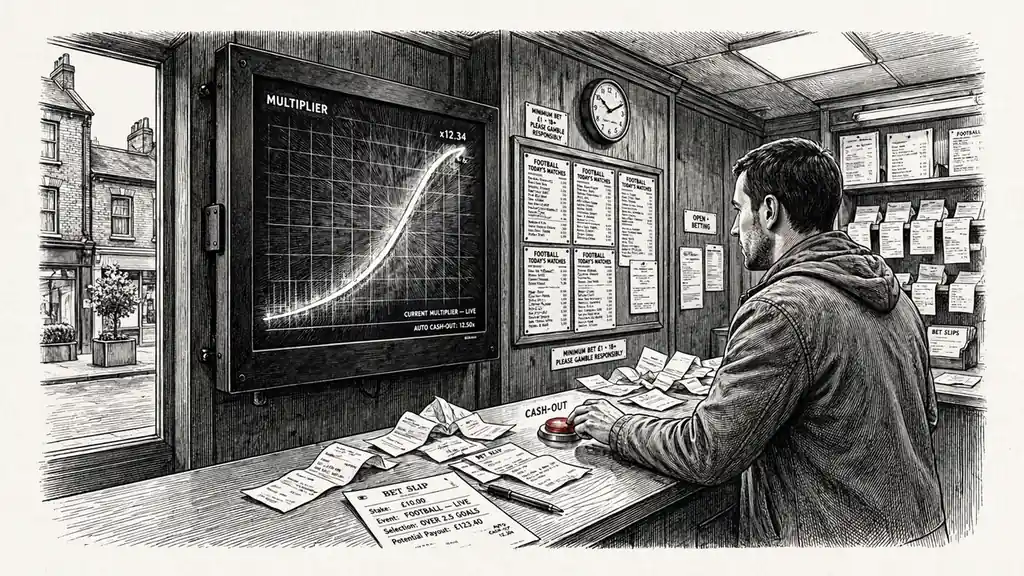
Table of Contents
- Crash Casino Games: How the Format Works
- How UK Crash Casinos Are Regulated
- Playing Crash Games Through an Online Casino
- What Makes a Crash Casino Game Suitable for UK Play
- Crash Casino Game UK 2026: Rules, Bonuses and Restrictions
- Crash Casino Games for Real Money
- Crash Game Providers and Provably Fair Claims
- Crypto Crash Casinos and UK Compliance
- Crash Casino Demo Play Without a Deposit
- How to Play a Crash Casino Game
Crash Casino Games: How the Format Works
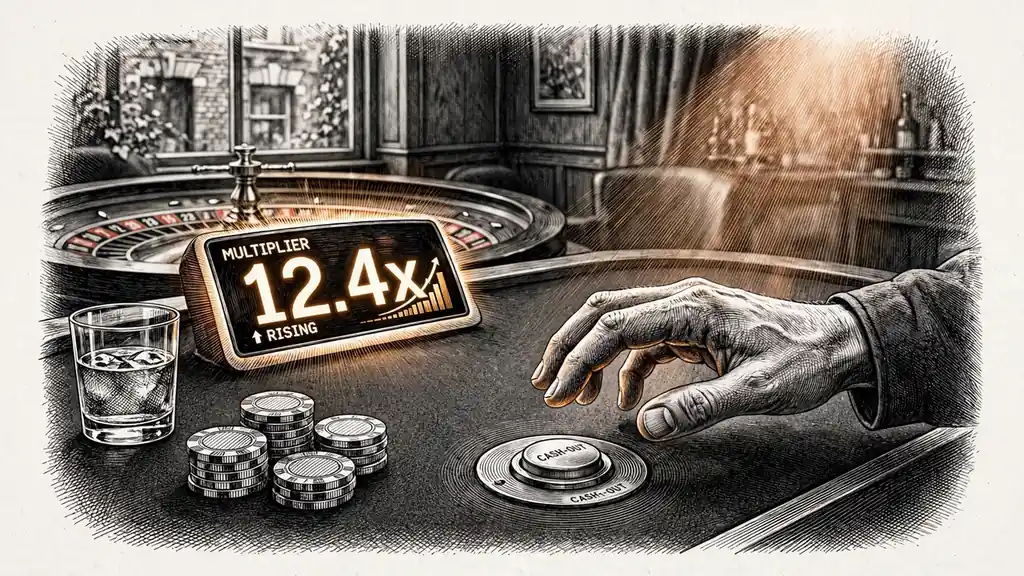
Crash casino games are a distinct casino format built around a rising multiplier. A round begins with a displayed value that increases as the game continues. The central decision is whether to cash out before the multiplier crashes. If the cash-out takes place in time, the stake is settled according to the multiplier shown at that moment. If the crash occurs first, the stake for that round is lost.
This structure differs from a conventional slot or table game because the outcome is presented as a visible sequence rather than as a single result revealed immediately. The multiplier creates a changing value during the round, while the player decides when to end exposure to the round. That decision is the main interactive feature of casino crash games, but it does not remove the role of chance.
The basic round structure
The format can be described in four stages:
- A stake is selected before the round begins.
- The multiplier starts to rise.
- A cash-out decision may be made while the round remains active.
- The round ends when the cash-out occurs or the multiplier crashes.
This page highlights operators worth considering for crash casino gaming in the UK in 2026. Use the listed licence, bonus, payout timeframe and minimum deposit details to identify an option that fits your priorities.
License: UKGC Operator Licence · Bonus: £50 bonus · Payout speed: Within 48 hours · Min. deposit: £10 Platinum Gaming Limited holds a UKGC Operator Licence and offers a £50 bonus. Its minimum deposit is £10, with payouts stated as arriving within 48 hours.
License: UKGC Operator Licence · Bonus: £20 bonus · Payout speed: Within 48 hours · Min. deposit: £10 Silverbond Enterprises is listed with a UKGC Operator Licence and a £20 bonus. Players can start with a £10 minimum deposit, while payouts are stated as arriving within 48 hours.
License: UKGC Operator Licence · Bonus: £100 bonus · Payout speed: Within 24 hours · Min. deposit: £10 ProgressPlay Limited combines a UKGC Operator Licence with a £100 bonus. The minimum deposit is £10, and payouts are stated as arriving within 24 hours.
License: UKGC Operator Licence · Bonus: £100 bonus · Payout speed: Within 24 hours · Min. deposit: £10 Genesis Global Limited is listed under a UKGC Operator Licence and provides a £100 bonus. It has a £10 minimum deposit, with payouts stated as arriving within 24 hours.
License: UKGC Operator Licence · Bonus: £200 welcome bonus · Payout speed: Within 48 hours · Min. deposit: £10 32Red holds a UKGC Operator Licence and advertises a £200 welcome bonus. The minimum deposit is £10, while payouts are stated as arriving within 48 hours.
License: UKGC Operator Licence · Bonus: £100 bonus · Payout speed: Within 24 hours · Min. deposit: £10 LeoVegas is listed with a UKGC Operator Licence and offers a £100 bonus. Its minimum deposit is £10, with payouts stated as arriving within 24 hours.
The exact interface can differ between games, but this sequence defines the basic crash-game model. A rising multiplier may create the impression that the value is accumulating in a predictable way. It is important to distinguish the visible movement from the underlying result: the increase does not establish how long the round will continue.
A cash-out at a lower multiplier produces a smaller potential return but ends the round earlier. Waiting for a higher multiplier increases the possible return if the round continues, while also increasing the possibility that the crash occurs before the cash-out. The decision therefore involves a trade-off between a lower locked-in multiplier and greater exposure to the unresolved outcome.
Why the multiplier does not provide a forecast
The multiplier is a settlement value, not a forecast of the next stage of the round. A sequence of rising rounds does not demonstrate that another long round is due, and a short round does not make a longer one more likely. Past results cannot establish the timing of a future crash.
Online casino game outcomes are determined by a Random Number Generator, or RNG. An RNG is a complex algorithm that produces sequences of numbers intended to be statistically independent and unpredictable. In a crash game, the RNG is used to determine the round outcome, including the point at which the multiplier ends. The changing display communicates the progress of that outcome; it does not give a reliable method for predicting it.
This distinction matters because the format encourages visual interpretation. A rapidly increasing multiplier can make continuation appear attractive, while a sudden crash can make the next round seem likely to behave differently. Neither reaction changes the mathematical basis of the game. A player may choose a cash-out point, but cannot turn that choice into control over the crash event.
Chance and the house edge
Crash casino games remain games of chance even though they include a decision during the round. The cash-out action affects the result of the individual stake, but it does not eliminate uncertainty over whether the chosen point will be reached. The operator’s mathematical advantage remains part of the game design.
The house edge is the built-in mathematical advantage the casino has in a given game. All casino games are designed with a house edge, meaning that the operator will profit over time. This does not mean that every round or every individual session produces a profit for the operator. Short-term results can vary, and a player can cash out successfully at a favourable multiplier. The house edge describes the long-term mathematical relationship between stakes and returns, not the guaranteed result of one round.
A successful cash-out should therefore be understood as a result within the game’s probability structure, rather than evidence that the format has become predictable. Equally, a loss after waiting for a higher multiplier is not proof that the game adjusted itself in response to the decision. The round outcome and the timing of the cash-out must be considered separately.
Terminology used in the format
Several expressions describe the same general category. “Crash casino games” is the broad term for casino games using a rising multiplier and a crash point. “Crash games” is a shorter form commonly used in online casino descriptions. “Online casino crash games” identifies the internet-based setting, where the game is offered through a casino website or app.
Online casino
A website or app where users play casino-style games over the internet using real money.
An online casino is a website or app where users play casino-style games over the internet using real money. Within that setting, a crash game is not a sports wager or a conventional casino table game. Its defining features are the multiplier, the unresolved round, and the cash-out decision.
Search labels such as “best crash casino games” or “top crash games casino” do not describe a separate mathematical category. They are comparative phrases that may refer to presentation, available features or the surrounding casino service. The underlying format remains the same: a stake is exposed to a randomly determined crash point, and the potential settlement depends on whether and when a cash-out occurs.
For crash casino games UK, the same mechanics apply. The important conceptual point is that an interactive cash-out feature does not change a chance-based game into a skill game. The multiplier can make the round more engaging to observe, but it cannot provide certainty about the next outcome or remove the house edge.
How UK Crash Casinos Are Regulated
Crash casinos operating online in Great Britain fall within the same regulatory framework as other remote casino services. The format of the game does not create a separate legal category. Whether a site offers a rising-multiplier game, table games, slots or several of these products, the operator must meet the requirements that apply to online gambling offered to consumers in Great Britain.
The UK licensing requirement
The UK Gambling Commission oversees gambling activities in Great Britain. The primary legislation is the Gambling Act 2005, under which the regulator issues operating, personal and premises licences. For an online service, the relevant permission is a remote operating licence.

An online casino offering crash games to customers in Great Britain must hold a valid UK Gambling Commission licence. This requirement applies regardless of where the company is based. A site cannot avoid the British licensing framework merely by locating its business, servers or ownership outside the country.
The licence concerns the operator rather than the visual design or title of an individual game. Consequently, a site presenting itself as one of the best crash casinos UK players can access is not legally established by its branding, game selection or advertising. Its status depends on whether the business providing the gambling service is authorised.
The UK Gambling Commission maintains a public register of current operating and personal licences. A casino’s licence can be checked by matching the operator’s name or licence number against that register and confirming that the domain listed there corresponds with the website being used. This distinction matters because a valid licence may belong to a particular legal entity and domain, not automatically to every website using a similar name.
What licensing means for crash game casinos
A remote operating licence places the gambling service within the regulator’s supervisory framework. It does not turn a crash game into a risk-free product, nor does it imply that every customer will win. The regulatory question is whether the operator is authorised to provide online gambling and is subject to the applicable controls.
This applies equally to descriptions such as online crash casinos, crash casino sites UK, or casinos online offering crash games. The terminology used in marketing does not alter the legal test. If the service accepts customers in Great Britain for online casino play, a UK Gambling Commission licence is required.
Unauthorised Gambling
Unlicensed or unauthorised gambling operations are a criminal offence.
Unlicensed or unauthorised gambling operations are a criminal offence. For that reason, a website’s claim to serve British customers is not evidence of lawful operation. The relevant evidence is the entry in the regulator’s public register and the match between the registered domain and the site in question.
Age verification and access
The general legal gambling age in the UK is 18 for both online and land-based gambling. Operators must verify that a player is at least 18 before allowing deposits or play. This applies to crash games casinos in the same way as to other online casino products.
Age verification is therefore a condition of access, not an optional account feature. A site that permits a person to deposit or play before establishing that the person is 18 or older is not meeting the stated UK requirement. The presence of a registration form or a responsible-gambling page does not, by itself, demonstrate compliance.
Identity controls are also part of the licensed environment. KYC, or Know Your Customer, is mandatory for UK-licensed casinos. The operator is responsible for establishing the customer’s identity and applying the relevant checks before allowing gambling activity under the licence.
GAMSTOP and self-exclusion
UK online casinos must participate in GAMSTOP for self-exclusion services. GAMSTOP allows a person to exclude themselves from all UK Gambling Commission-licensed gambling sites for a selected period of six months, one year or five years.
The system is broader than a restriction applied to one account or one brand. Its scope covers all UKGC-licensed gambling sites, so a customer enrolled in GAMSTOP should not be able to move from one licensed crash casino to another in order to continue gambling during the exclusion period.
This makes the operator’s licensing status significant for self-exclusion as well as legality. A site outside the UKGC framework is not equivalent to a participating licensed casino, even if its interface, game titles or promotional language resemble those of regulated services. GAMSTOP is a feature of the licensed British system, not a general technical function found on every international gambling website.
The regulatory boundary
UK regulation attaches to the gambling service and the operator. It does not depend on whether the product is described as a casino crash game, an aviator-style game, or a different crash format. Nor does a game’s popularity, presentation or provider name establish that a website may lawfully offer it to customers in Great Britain.
Accordingly, the central checks are structural: the operator must hold the appropriate remote operating licence, verify that customers are 18 or older, use mandatory KYC controls and participate in GAMSTOP. These conditions identify the regulated route to crash casino play without suggesting that regulation removes the inherent financial risk of gambling.

Playing Crash Games Through an Online Casino
An online casino is a website or app through which casino-style games are played over the internet with real money. A crash game offered in that environment is therefore part of the casino’s wider catalogue rather than a separate form of gambling infrastructure. Access may be through a desktop browser, a mobile browser or an application, depending on the operator’s service. The route changes the interface, but it does not change the need for an account, identity checks or the operator’s responsibility for the games it supplies.
Account access and onboarding
Opening an account normally involves providing personal information and completing KYC (Know Your Customer) checks. For a UK-facing service, age verification is essential: operators must establish that a player is 18 or older before allowing deposits or play. Identity and payment information may therefore be requested before the crash game becomes available, rather than only when a withdrawal is made.
Account Onboarding
- Complete necessary KYC (Know Your Customer) checks
- Verify identity and age requirements
- Set up deposit and payment information
The distinction matters because an account is not merely a login. It connects the player to deposit controls, transaction monitoring, promotional terms and exclusion tools. A service that permits play without meaningful identity or age verification does not provide the same safeguards as a properly controlled online casino.
Some information about onboarding is reported differently across sources. A profile review states that operators prompt new customers to set a financial limit before the first deposit. This point should be treated as a reported practice from that source rather than presented as a general market rule. The purpose of such a prompt is nevertheless clear: it places a spending decision before gambling begins, when the account holder is not already engaged in play.
Financial controls can also operate after the account is active. A profile review reports that financial vulnerability checks apply when net deposits exceed £150 in a rolling 30-day period. That threshold should likewise be attributed to the source rather than treated as a universal condition for every UK online casino. Transaction monitoring remains part of the operator’s broader responsibility where there are signs of gambling harm.
Browser and app use
A browser-based crash casino can be opened without installing software, while an application may provide a dedicated mobile interface. Neither format should be treated as evidence of fairness or legality by itself. The relevant questions concern the service behind the interface: whether it is authorised to accept customers in Great Britain, whether its account controls function properly and whether the game has been tested before being made available.
The game’s outcome is determined by a Random Number Generator. Before a game is offered by a UK-licensed casino, its RNG must be tested and certified by an independent testing laboratory. The testing requirement applies to the game’s underlying operation, not merely to its visual presentation in a browser or app.

The casino must also display the game’s Return to Player (RTP). RTP is a long-run mathematical measure calculated over millions of rounds, not a prediction for a particular account or session. Displaying it allows the game information to be examined before play, while leaving the result of any individual round uncertain.
Licensed service or unauthorised site
A UK customer faces a material difference between a licensed online casino and an unauthorised site. Operators providing online gambling services to consumers in Great Britain must hold a UK Gambling Commission licence, regardless of where they are based. For remote gambling, the relevant form is a remote operating licence.
Licence status can be checked against the UK Gambling Commission’s public register by matching the operator’s name or licence number and confirming that the listed domain corresponds with the site being used. A familiar design, an app download or the presence of a crash game does not replace that check.
An unauthorised website may still display casino terminology, payment instructions and game interfaces, but those features do not establish UK authorisation. Unlicensed or unauthorised gambling operations are a criminal offence, and the service may not provide the protections associated with a UK-licensed account. The distinction is therefore practical rather than semantic: it affects age controls, KYC, game testing, financial safeguards and the handling of gambling-related concerns.
For a UK online crash game, the casino setting is consequently defined by more than access. The browser or app supplies the route to the game; the account process establishes eligibility; the licence determines the regulatory framework; and the displayed game information provides the basic record against which the offering can be assessed.
Summary of Suitability
- Ensure the game is available through a UK-licensed casino
- Check for independent laboratory certification of the RNG
- Verify that the displayed RTP is clear and specific to the game
- Confirm that platform fairness has been audited
What Makes a Crash Casino Game Suitable for UK Play
A suitable crash casino game for UK play should be assessed through evidence about its mathematics, randomness and testing rather than through branding alone. Terms such as “best crash casino UK” or “best crash game casino” do not identify an objective category. They describe a comparison task, and that comparison is meaningful only when the underlying game information can be checked.
Certified randomness
The first criterion is the integrity of the Random Number Generator (RNG). In a crash game, the result of a round must be generated by a system designed to produce statistically independent and unpredictable sequences. Before a game is offered by a UK-licensed casino, its RNG must be tested and certified by an independent testing laboratory.
This requirement matters because the visible multiplier is not evidence of fairness by itself. A rising number, an animation or a prominent “crash” label describes presentation, not the mechanism producing the result. The relevant evidence concerns whether the random process has been examined independently and whether the game behaves according to its declared mathematics.
Independent laboratories can test RNG integrity, verify that the game mathematics correspond to the advertised Return to Player (RTP), and audit platform fairness. These checks address different questions. RNG testing concerns the generation of outcomes; mathematical verification concerns the expected return; a platform audit considers whether the surrounding system operates as represented. A game that provides only promotional language, without identifiable testing evidence, offers a weaker basis for comparison.
Displayed RTP and mathematical fairness
UK-licensed casinos must display the RTP for each game. RTP is a long-run statistical measure calculated over millions of game rounds, not a forecast for a particular session. It therefore helps describe the expected relationship between stakes and returns across a very large number of rounds, while saying little about the result of one player’s short period of play.
A higher RTP indicates a lower house edge. The house edge is the built-in mathematical advantage held by the casino, and it remains relevant even when the advertised RTP appears favourable. A game with a higher RTP is not automatically a winning opportunity for an individual player, because the long-run calculation does not determine the outcome of each round.
This distinction is especially important when comparing products described as a crash slot, slot crash game or crash game slot. Some labels may place a crash game beside conventional slots, but terminology does not establish equivalent mathematics. The displayed RTP and the supporting explanation are more informative than the category name. Where no RTP is shown, the game cannot be assessed against the same evidence standard.
What a careful comparison can establish
A comparison of crash games can reasonably examine:
- whether the game is available through a UK-licensed casino;
- whether an independent laboratory has tested and certified its RNG;
- whether the displayed RTP is clear and tied to the specific game;
- whether independent testing covers the correspondence between the game mathematics and that RTP;
- whether platform fairness has been audited.
These criteria apply equally to searches for the best crash slots and to interest in a BTC casino crash product. A payment method or account model does not, by itself, demonstrate that the game is fair. Nor does the use of “slot” in a product description establish that a game has the mathematical characteristics of a conventional slot.
The same standard applies to any proposed crash casino game rules. Rules should explain the relevant round mechanics and cash-out conditions, but readable rules are not a substitute for certified randomness or disclosed RTP. The strongest game-level evidence combines clear rules with independently tested RNG integrity, verified mathematics and transparent RTP information. Even then, RTP remains a statistical expectation over millions of rounds, not a guarantee of an individual winning session.
Crash Casino Game UK 2026: Rules, Bonuses and Restrictions
Promotions attached to a crash casino game in the UK are governed by their terms, not by the game’s multiplier format. A bonus may affect the amount available for play, the games that qualify, the permitted stake, the time available to complete wagering requirements and the conditions for withdrawing funds. These details apply to a crash game casino offer in the same way that they apply to other eligible casino games.
Wagering Caps
Since January 2026, wagering requirements on bonuses have been capped at a maximum of 10x.
The 2026 wagering limit
A specialist industry review reports that wagering requirements on bonuses have been capped at a maximum of 10x since January 2026. This should be distinguished from older promotional examples in which the required wagering could be substantially higher. The cap concerns the wagering requirement attached to the bonus; it does not remove other conditions, such as game restrictions, maximum withdrawal provisions or expiry terms.
The practical effect depends on how the promotion is defined. If the requirement is calculated against the bonus alone, the relevant wagering base is the bonus amount. If the terms combine the deposit and the bonus, the calculation is different. The promotional wording therefore remains decisive, even where the stated multiplier is within the permitted maximum.
For comparison, a specialist industry review describes a £10 bonus with a 40x wagering requirement as requiring £400 in wagering before conversion into cash. That example illustrates why the 2026 cap changes the possible structure of new offers, while also showing that historical or non-compliant terms should not be treated as equivalent to current conditions.
Terms that can restrict withdrawals
A Welcome Bonus may require the bonus amount to be wagered between 20 and 40 times before withdrawal, according to a specialist industry review. The same source type should not be treated as evidence that every UK operator uses those conditions. Each offer must be assessed through its own published terms.
Relevant restrictions can include:
- wagering requirements and the method used to calculate them;
- which games contribute to wagering;
- maximum bet limits while a bonus is active;
- expiry periods;
- maximum withdrawal caps;
- restrictions on combining promotions;
- identity or account checks before funds are released.
A crash casino may therefore advertise an apparently simple bonus while applying conditions that materially affect its value. A game can be eligible but contribute only partially to the wagering target, or it can be excluded altogether. A withdrawal request may also be limited by a promotional cap even when the balance includes funds generated during play.
Assessing offers in 2026
For casinos with crash games, the relevant comparison is not the headline bonus alone. The terms should state whether the crash casino game qualifies, how bets are counted and what happens to restricted funds when the promotion expires or is cancelled. The wording should also identify any maximum stake and withdrawal conditions before activation.
These checks apply equally to traditional operators and crypto casinos with crash games. The payment or account model does not replace the need to examine promotional restrictions. A clearly stated offer provides the necessary basis for evaluating a crash casino UK promotion; an incomplete description does not establish what can ultimately be withdrawn.
- Read the full published terms and conditions
- Check if the crash game qualifies for wagering
- Identify maximum stake and withdrawal limits
- Rely solely on the headline bonus amount
- Assume historical terms apply to 2026 offers
Crash Casino Games for Real Money
Playing crash games for real money changes the significance of every decision. In a free version, a missed cash-out affects only the simulated balance. With real stakes, the same game mechanics determine whether funds are retained or lost. The multiplier remains a changing figure rather than a prediction, and no strategy can remove the underlying mathematical disadvantage built into a casino game.
How the house edge affects real-money play
All casino games are designed with a house edge. This is the operator’s mathematical advantage, expressed through the relationship between the game’s expected return and the amount staked. Over time, that advantage is intended to produce a profit for the casino, although individual results can differ substantially from the long-term expectation.
Return to Player (RTP) provides a theoretical measure of that expectation. A higher RTP corresponds to a lower house edge, but RTP is calculated across millions of game rounds rather than a single session. It therefore cannot establish whether one player will finish a particular round, evening or sequence of wagers ahead.
A game with a 2.7% house edge has a 97.3% RTP. That figure describes the mathematical design of the game across a very large number of rounds; it does not mean that 97.3% of an individual stake will be returned, nor that a session will produce a comparable result. A player may win or lose considerably more than the theoretical percentage suggests during short-term play.
Real-money risk and the limits of strategy
A crash casino strategy may organise staking or determine when a player prefers to cash out, but it cannot alter the game’s built-in probability. Calling a game fair does not mean that every session has an equal chance of ending profitably. Fairness, in the technical sense, concerns whether the stated game mechanics and outcomes are properly implemented; it does not remove the house edge.

This distinction is important when comparing real-money crash games with crash casino free play. Free play can illustrate the interface and demonstrate how a rising multiplier and cash-out decision interact, but it does not reproduce the financial consequences of wagering. Real-money play introduces the possibility of losing deposited funds, even when a session begins with successful rounds.
UK players pay no gambling tax on winnings. That tax treatment does not convert a negative-expectation game into an investment or protect a bankroll from losses. The relevant financial question remains whether the stake can be lost without affecting essential expenditure. The absence of gambling tax is therefore separate from the probability structure of a real-money crash casino.
A cautious assessment should distinguish three claims: a displayed RTP may describe long-run theoretical return; a fair game may use correctly implemented outcomes; and neither claim guarantees an individual winning session. Those limits apply regardless of the chosen stake or the preferred crash game strategy.
Crash Game Providers and Provably Fair Claims
A crash game provider supplies the software used by a casino, but the provider’s name alone does not establish that a game is fair. Fairness depends on how the game’s random outcomes are generated, tested and monitored. This distinction matters because “provably fair” is a broader marketing expression than independently verified casino-game fairness.
What independent testing establishes
For a crash game available through a UK-licensed casino, the Random Number Generator (RNG) must be tested and certified by an independent testing laboratory before the game is offered. An RNG is a complex algorithm that produces sequences of numbers designed to be statistically independent and unpredictable. Certification therefore concerns the technical process used to generate outcomes, rather than the reputation of a particular crash game provider.
RNG Certification
Certification concerns the technical process used to generate outcomes, ensuring the Random Number Generator produces statistically independent and unpredictable sequences.
Independent laboratories assess RNG integrity and check whether the game mathematics correspond with the advertised Return to Player (RTP). They also audit platform fairness. These checks create a basis for evaluating software supplied by crash game providers without treating promotional language as evidence.
RTP is a mathematical property calculated across millions of game rounds, not a prediction about one session. Verification that the mathematics match the published RTP does not mean that a particular sequence of crash multipliers will produce a profit. It confirms that the implemented game model corresponds with the stated theoretical return.
Interpreting “provably fair”
A provably fair crash casino normally refers to a system in which elements of the outcome can be independently checked through cryptographic or mathematical procedures. That label may describe a technical verification model, but it does not, by itself, prove that the operator is licensed, that the platform has undergone a full fairness audit, or that the advertised RTP is accurate.
Consequently, claims about provably fair crash games should be separated from laboratory certification. The relevant evidence includes an identified testing laboratory, a certification covering the RNG, verification of game mathematics against the advertised RTP, and an audit of platform fairness. Where such evidence is absent, the provider’s branding remains a claim rather than an independently established finding.

Crypto Crash Casinos and UK Compliance
A crypto crash casino uses cryptocurrency as part of its account or payment model; it does not create a separate category of game mathematics. The multiplier mechanism, random outcome and cash-out decision remain properties of the crash game. Crypto affects how an account is funded, how balances are represented and how transactions may be handled, but it does not establish that a game is fair or unfair.
For customers in Great Britain, the regulatory question concerns the operator’s service. An online casino offering gambling to UK customers must hold a valid licence from the UK Gambling Commission. For remote gambling, the relevant authorisation is a remote operating licence. The UK Gambling Commission oversees gambling activities in Great Britain, so the use of cryptocurrency does not remove an operator from the applicable regulatory baseline.
What crypto does not prove
Terms such as “crypto crash casino” or “crash casino crypto” describe a commercial and payment arrangement, not evidence of licensing, randomness or player protection. A cryptocurrency balance is not a substitute for:
- a valid UK Gambling Commission licence;
- an identifiable operator responsible for the service;
- compliance with the requirements attached to remote gambling in Great Britain;
- clear information about the game and account conditions.
The label “provably fair” also requires careful interpretation. Cryptographic verification may relate to a particular game mechanism, but it does not by itself demonstrate that the operator is authorised to provide gambling services to customers in Great Britain. Nor does a blockchain-based transaction establish that the game has been independently tested.
Compliance and responsible gambling
Crypto-oriented services can make the boundary between account activity and gambling activity less obvious, particularly where balances are displayed in digital assets. That distinction does not change the need to assess whether the service is legally available to UK customers. Unauthorised gambling operations are a criminal offence, and the absence of a UKGC licence is therefore a substantive compliance issue rather than a minor account feature.
The central test for a crypto casino crash game is consequently twofold: whether the game’s fairness evidence is credible, and whether the operator has the required UK authorisation. Neither question can be answered solely from the payment method or the presence of cryptocurrency.
Compliance Requirement
Operating a crypto crash casino in Great Britain requires a valid UK Gambling Commission remote operating licence.
Crash Casino Demo Play Without a Deposit
A crash casino demo provides a simulated version of the game without requiring a deposit or placing real funds at risk. Its main value is familiarisation: the interface, round presentation and cash-out controls can be examined before financial stakes become part of the activity. This makes demo access distinct from real-money play, where each decision has a monetary consequence.
What Demo Play Shows
A crash game demo normally reproduces the visual sequence of a round. The multiplier begins to rise, the round ends at an unpredictable point, and the interface records whether a simulated cash-out occurred before the crash. The exact presentation varies between games, so demo play can help identify the location and function of key controls without treating the format as a strategy exercise.
A crash casino game demo can also clarify how simultaneous rounds are displayed, whether an automatic cash-out setting is available, and how previous outcomes appear on screen. These are interface features rather than evidence of future results. Previous simulated rounds do not establish a pattern for the next round.
Limits of a Crash Slot Demo
The expression “crash slot demo” is sometimes used broadly for a free-play crash game, although crash games and slots are different formats. A free version may reproduce the same round logic as the paid version, but the relevant outcome mechanism remains chance-based. Online casino game outcomes are determined by a Random Number Generator, so observing a sequence in demo mode cannot make a later result predictable.
Demo play is also unsuitable for assessing personal profitability. RTP is calculated over millions of game rounds rather than individual sessions. A simulated session therefore cannot show what a particular real-money session would return, and it cannot remove the mathematical risk associated with wagering.
Used narrowly, a crash demo casino is an orientation tool: it explains the interface and round structure while keeping financial stakes outside the exercise. It should not be presented as proof of fairness, a winning method or a forecast of future outcomes.
How to Play a Crash Casino Game
A crash game uses a simple sequence, although the financial outcome remains uncertain. The practical process is as follows:
- Open the game and review the round controls. The interface normally shows the current multiplier, stake field and cash-out control. The available options depend on the particular game.
- Select a stake. The amount is entered before the round begins. It represents the money at risk for that round, so it should be treated as a fixed gambling expense rather than as a forecast of returns.
- Start the round and watch the multiplier rise. After the round starts, the displayed multiplier increases until the game crashes. The crash point determines whether a cash-out instruction has succeeded.
- Cash out before the crash. If the cash-out is completed while the multiplier is active, the stake is settled according to that multiplier. If the crash occurs first, the stake for that round is lost.
- Review the result without treating it as a signal. A previous crash point does not establish what the next round will do. Repeating a stake, changing it after a loss or waiting for a particular multiplier does not remove the game’s uncertainty.
The central decision is therefore timing, not the discovery of a reliable winning system. The house edge is the built-in mathematical advantage held by the casino, and it applies despite the game’s rapid feedback and visible multiplier. A higher Return to Player (RTP) indicates a lower house edge, but it does not guarantee a winning individual session. RTP describes results across millions of rounds, not the outcome of one round or a short sequence.
Demo play can clarify the controls without financial stakes; real-money play introduces the possibility of losing the selected stake. The format offers a straightforward operating procedure, but no cash-out point can convert a chance-based game into a predictable source of income.
Are online casinos in the UK safe and regulated?
Yes, online casinos serving UK customers must hold a valid remote licence from the UK Gambling Commission. Their games use tested RNGs, and licensed operators must display each game’s RTP.
Can I play dice games for free at UK casinos?
No answer is supported by the available information.
Are online dice casinos legal in the UK?
Yes, online casino games are legal when the operator holds a UK Gambling Commission licence. The specific game format does not create a separate legal category.
Is craps legal to play online in the UK?
No answer is supported by the available information.
What is the best dice casino game for UK players?
No answer is supported by the available information.
Are crypto dice casinos safe for UK players?
No answer is supported by the available information.
What is the easiest casino dice game to learn in a UK casino?
No answer is supported by the available information.
Can I get a no deposit bonus for dice games in the UK?
No answer is supported by the available information.
Published by the Casinouk Bonuses Info team.